Background
At the turn of the millennium, the world’s growing reliance on digital technology was accelerating at an incredible speed. This led to an unprecedented growth in demand for data processing and storage capabilities. As the internet became mainstream and information technology rapidly grew to become the backbone of global trade, traditional on-site infrastructure gradually began to fall behind the growing demands of more technologically intensive use cases. In response, some organizations began outsourcing data management and processing to specialized data centers. These large, purpose-built complexes were designed to support vast arrays of processing hardware, plus all the necessary associated power, cooling, and safety infrastructure.
The 2020’s have again seen a shakeup to traditional data infrastructure. From Chat GPT’s public rollout at the turn of the decade to the creation of sophisticated AI investment tools, automated video production programmes and even self-driving cars, both business and consumer demand for AI has boomed. To keep up with this demand, over 10,000 dedicated data centers have been built globally, with the construction of new facilities set to accelerate further in the coming years. With businesses placing ultimate trust in the reliability of their outsourced AI infrastructure, downtime, inefficiency, or poor organization can spell disaster for service providers.
In the following article, we will discuss the role of labeling within effective data center management, recommended design/content elements, and delve into the challenging conditions that data center labels are expected to resist.
Data Center Applications
With uptime being critical in AI data centers, quick diagnosis can save bottom lines from crumbling. In the sprawling labyrinths that make up server networks, consistent labeling with concise and clear information can cut down on wasted time in both day-to-day facilities management and in disaster scenarios or large-scale malfunctions.
There are several key measures that AI data centers can take to ensure their labeling practices do not slow response times during vital moments. When systems are labeled to a recognized or at least consistent standard, technicians can quickly identify and trace affected components, modifications can be made with minimal risk of service disruption, and third-party maintenance staff can begin work immediately without needing to interpret confusing in-house labeling schemes.
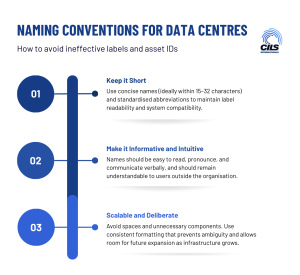
Guidelines for forming a practical naming convention within a data center.
Data centers can be vast, often spread across multiple buildings and sites, with some operators managing networks that span several geographies. When a single cable needs replacing or a rack requires servicing, service engineers should not be sent on a time-consuming search to locate the correct components.
Fortunately, technicians can rely on established best-practice guidance. The ANSI/TIA-606 Telecommunications Infrastructure Administration Standard addresses the administration, identification, labeling, and records management of telecommunications and structured cabling infrastructure (including cabling, pathways, racks, and spaces). Widely recognised as industry best practice and frequently specified in contracts for data-center construction and network-infrastructure projects, the standard defines “administration classes” that enable environments ranging from small rooms to large multi-site operations to implement labeling and documentation approaches appropriate to their scale and complexity.
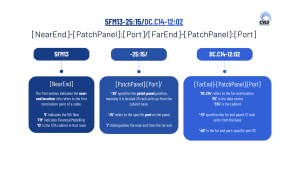
Example illustration of an ANSI/TIA-606-compliant label’s sections and contents.
In addition to ANSI/TIA-606 compliance across pathways and cabling networks, consistent and logical naming conventions for other components can further reduce operational friction in larger facilities. Although most centers develop bespoke naming systems to accommodate legacy environments and operational nuances, best practice is for server, rack, and hardware naming conventions to be simple enough to explain through a brief guide or infographic.
For example, if a third-party engineer is called in to service three legacy racks across a 100-acre site, the absence of geographic coordinates or clear floor and room identifiers can add unnecessary steps to the visit. What may be considered merely inconvenient during routine servicing has the potential to become catastrophic during emergencies. This is why, when naming conventions are set, managers should ensure their labeling is free of irrelevant or confusing information and, where possible, follows externally recognised standards.
Labeling Components
Most elements of network infrastructure benefit from purpose-designed identification appropriate to their function and environment. For example, cables are typically labeled with self-laminating wrap-around designs or flag labels. Alternatively, panels will often utilize precision-fit adhesive labels aligned to standard port spacing. Server and rack labels usually adopt larger formats, offering space for clear text, barcodes, or QR codes to support tracking and asset management.
Additionally, in AI data centers, labels intended for hazard warnings, warranty protection, or heating and humidification control should be designed in accordance with durability and regulatory standards appropriate to the operating environment and geographic conditions.
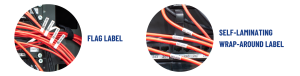
Photographic example of a flag label and a self-laminating wrap-around label
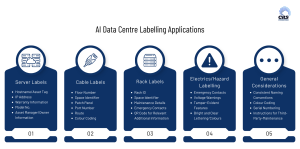
Categories of data center labeling applications
Durability Considerations
Having established where labels are needed and what they must contain, the next critical consideration is the consequence of using the wrong label materials. From our experience, AI data-center environments frequently present conditions that standard labels are not designed to withstand. Exposure to elevated temperatures, high airflow, vibration and humidity can rapidly degrade unsuitable labels, causing them to lose adhesion, fade or become illegible. Over time, this deterioration increases the likelihood of identification errors, disrupts operational efficiency, and introduces unnecessary operational risk. That is why labels for AI data centers should be carefully specified to withstand environmental, mechanical, and lifecycle stresses, ensuring they remain readable and scannable for the full lifecycle of the asset.
Environmental Stressors
Heat
AI racks can push 40–120 kW or more in high-density deployments, with dense GPU clusters creating localized hotspots and uneven exhaust airflows that place sustained thermal stress on identification labels. When inappropriate materials are selected, such as paper-based labels or adhesives not rated for elevated temperatures, labels can dry out, discolor, curl, or lose adhesion prematurely, leaving critical asset information unreadable.
In hot aisles, ambient temperatures can reach 50–60 °C in high-density deployments. Combined with continuous thermal cycling, airflow, and mechanical vibration, unsuitable labels can fail easily.
At CILS, our specialist range of high-temperature label materials is designed to maintain performance under these demanding conditions, with options tested to withstand significantly higher temperatures than those typically encountered in data centers. Further details can be found on our Extreme Temperatures Label solutions page.
Moisture
Aggressive cooling through humid air intakes or economizer systems can create condensation spikes or transient moisture exposure that quickly reveal the weaknesses of unsuitable label constructions. Labels using paper facestocks, rubber-based adhesives, or aqueous adhesive systems can absorb moisture, soften, or lose bond strength, leading to edge lift, smearing, or complete detachment.
At CILS, we design specialist materials and adhesive systems engineered to resist moisture and humidity variation, ensuring labels remain securely adhered where standard paper-based facestocks would otherwise fail.
Airflow/Chemicals
High-velocity cooling airflows in contained aisles can, in localized exposure zones, contribute over time to gradual edge wear, particulate buildup, and adhesive degradation. While airflow alone is rarely the sole driver, it can accelerate label degradation by transporting harmful particulates, increasing lozalised abrasion, and interacting with temperature and humidity variations, creating cumulative environmental stress at exposed label edges.
Additionally, within data centers, regular cleaning of surfaces and components is necessary to prevent dust buildup and subsequent buildup on fans and cooling equipment. Frequent cleaning with alcohol wipes or pressurised air can gradually weaken label adhesives and cause printed information to fade or smear, compromising long-term identification of components.
Labels from CILS use durable synthetic materials, high-performance adhesives, and protected print technologies engineered to withstand airflow stress, particulate exposure, and even long-term operational handling.
Abrasion
Frequent rack access in cramped setups can lead to constant label contact with hands, tools, and cables, accelerating surface wear, while vibration from dense loads and fan arrays can introduce low-level micro-abrasion over time, particularly on cables and panels.
Labels made from low-grade paper with standard adhesives and exposed thermal print are especially vulnerable, as repeated handling quickly scuffs the print surface, edges begin to lift under cable movement, and vibration-driven rubbing gradually reduces legibility. In contrast, CILS labels use abrasion-resistant synthetic materials, high-performance long-life adhesives, and protected print layers designed to maintain attachment and readability despite frequent handling and ongoing mechanical vibration.
Lifecycle adhesion
Racks, structured cabling and some infrastructure components can remain in service for decades, while computer hardware, such as GPUs are typically refreshed more frequently. No matter the average lifespan of a component, appropriate labeling must always be selected to ensure legibility and secure bonding across the full lifecycle of the underlying infrastructure.
Durable labeling materials from CILS, when combined with correct application practices, are designed to last for the operational lifecycle of the product, helping service engineers and site managers reduce relabeling requirements and minimize compliance risks.
Conclusion
Labeling plays a critical role in AI data centers, particularly as regulated industries adopt LLMs and other AI-driven technologies and hyperscalers work to minimize operational risk. Poorly formatted or illegible labels remain two of the most common sources of identification errors, creating avoidable compliance and maintenance challenges. By implementing clearly standardised formats and durable, high-performance labeling solutions, operators can ensure long-term legibility, consistency, and reliability across diverse environments. While best practice processes are essential, the use of purpose-engineered durable labels provides an additional layer of assurance that identification systems remain robust as facilities scale and operational demands evolve.
If you are unsure about your specific labeling requirements, or would simply value a second opinion, click here to speak with one of our label specialists today.



 French
 German
 English