
Choose your industry sector:
11 Jun 2026
Author: CILS International
According to the UK Health and Safety Executive (HSE), 680,000 people sustained injuries in workplace-related incidents in the UK in 2025. That means that for every 100 workers, 2 will require time off over the course of a year due to a workplace accident. On an even more serious note, in Great Britain, 124 workers were killed in workplace incidents between 2024 and 2025. Of all workplace fatalities, over 28% occurred within the construction. In these environments, workers are in regular contact with heavy machinery and high-risk equipment, meaning that accidents reported in the workplace are often more severe than many other industries.
The prevention of workplace injury and death is a serious and multifaceted issue that cannot be fixed with one action alone. Although some causes of incident require huge structural shifts to reduce occurrences, in construction, agricultural and manufacturing sectors, machinery malfunction represents a frustratingly preventable cause of harm. In many cases, these failures are not sudden, but the result of issues that should be picked up during routine checks.
Injuries or fatalities caused by machinery or asset failure can lead to not just needless injury or loss of life, but also costly litigation, PR disaster and serious damage to operational capacity. Despite the catastrophic risk associated with such accidents many sites are stuck in old ways. This often means that safety inspections rely on manual or inconsistent processes, where checks are prone to human error during cataloguing and are difficult to track over time. It is against this backdrop that UK-based industrial technology company workMule was established.
Founded in 2021 by 3 construction experts with over 60 years of combined industry experience, WorkMule’s mission is to simplify pre-use inspection and remove paperwork from construction compliance protocols. The platform was designed with day-to-day site use in mind, making it easy for operators to complete checks without adding friction to existing workflows.
WorkMule’s innovative digital platform enables users to condense all asset inspections in seconds, in one place, allowing managers to identify risks and trends without the need for manual analysis. For site managers overseeing large numbers of assets, this means being able to quickly spot missed checks or recurring issues.
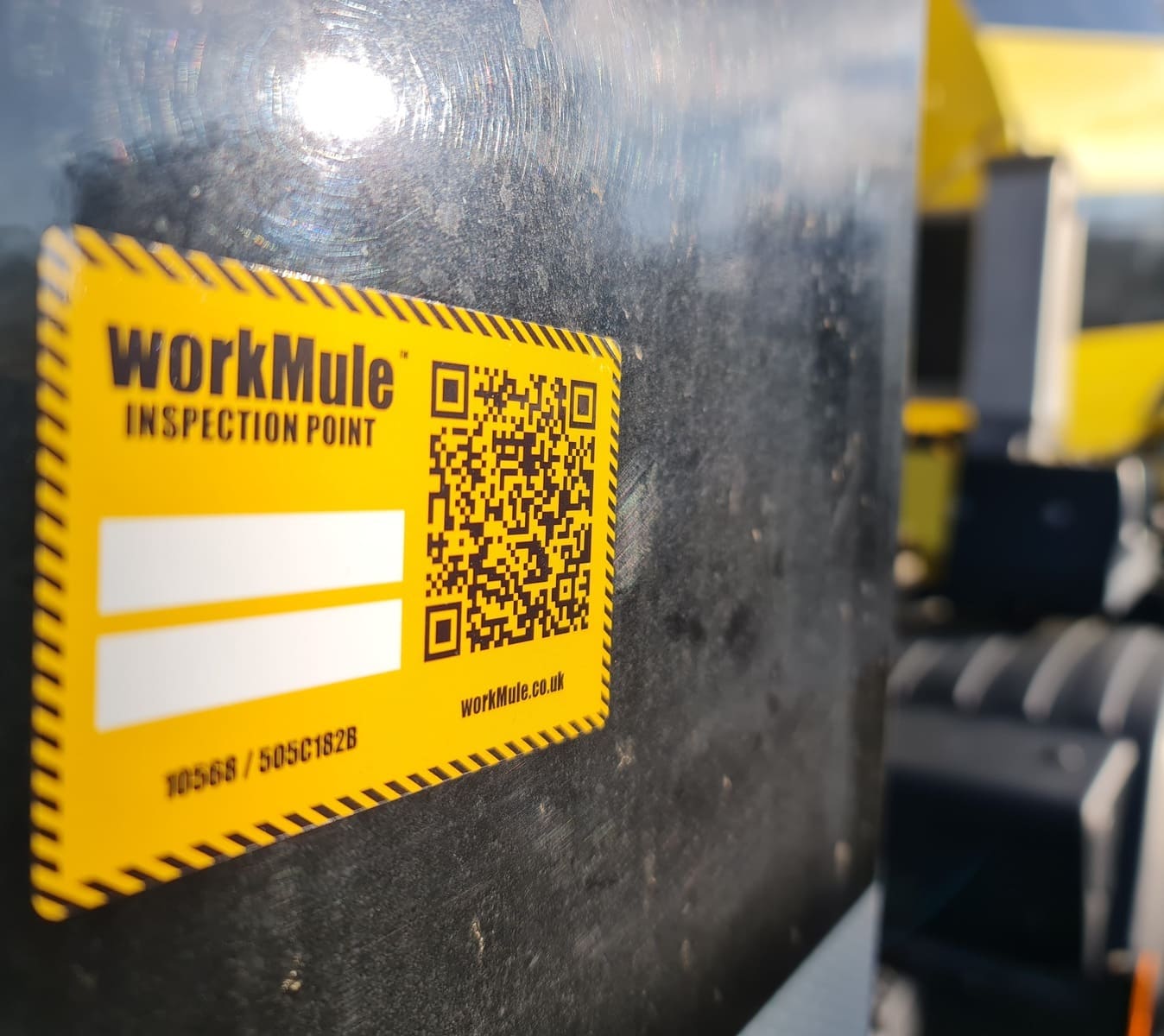
The platform’s functionality is supported by an array of unique QR codes, attached to each individual asset under management. These QR codes allow inspectors to quickly sign off on vehicle safety in a traceable manner.
Despite the platform working incredibly effectively against its value proposition for site managers, one unexpected hurdle was being reported across client sites. The issue wasn’t anything to do with the technology or user experience, instead it was the legibility of the QR access codes over time.
As the platform relies on these codes to access and complete inspections, any loss of legibility quickly becomes a practical issue on site. Building sites are far from an ideal environment for traditional labels. Dust, heat, oils, humidity, sun and rain exposure and repeated handling are all common sources of damage for labelling. In WorkMule’s case, the standard, [material] labels being used were showing signs of wear within months.
Due to the software’s reliance on delicate QR codes for functionality, even a centimetre of missing or faded facestock had the potential to cause vital safety checks to be missed. In practice, this meant that if a code could not be scanned, an assessment could be delayed or skipped. This is why workMule came to CILS.
Following a thorough examination by our label experts, we recommended WorkMule our CILS-TMYPET (LSE) material. This high-performance thermal transfer polyester label’s superior abrasion resistance and high tack adhesive made it the perfect choice for WorkMule’s application. This material was rapidly phased into both existing client asset networks and new orders to ensure that QR codes remain intact and scannable, even with repeated handling and exposure to the elements. Following a 2-year pilot of CILS’s labels across WorkMule’s supply chain, a remarkable 0 adhesive or facestock failures have been reported by clients.
“Partnering with CILS for our QR code stickers was one of the best decisions we’ve made. Our previous supplier let us down with repeated false promises, and the quality of our original stickers was starting to undermine our software product.
CILS delivered exceptional expertise, reliability, and value for money, and we’re excited to continue working with them to provide robust, scalable QR labelling solutions our customers can depend on.”
Paul Francis, Managing Director
It was great to partner with WorkMule on a solution built to withstand some of the harshest of outdoor conditions. Our industrial-grade labels are designed for durability so it’s rewarding to see them deliver reliable performance in such an important context.”
Jared Keys, UK Sales Director
We are extremely excited to be part of WorkMule’s journey across its more than 500 managed sites and for all future installations.
Both WorkMule and CILS International share a common focus: thriving in risk-averse environments. If you can think of a use case where label failure carries serious consequences, including risks to worker safety, always speak to the experts.
If you have concerns about the durability of your labels, speak to one of our experts today.
To find out more about WorkMule’s work, see their website here.
We are computer printable label specialists. Pure and simple.
With nearly 40 years of expertise, our tried-and-tested approach will diagnose the right label for your unique needs. We have built our reputation on consistently creating the highest quality durable labels with excellent customer feedback.
TEL: 0800 917 0024
Email: info@cils-international.com